Sep 16, 2026 • 7 min read
A patient books a slot, the front desk blocks the time, and then nobody walks through the door. No call, no text, just an empty chair and a doctor who could have seen someone else. Every clinic owner knows this scene. What most don't know is exactly how much it costs them, or how a well built digital system quietly fixes it in the background.
This is not a small operational hiccup. It is one of the most expensive, least discussed problems in outpatient care today. Let's break down why it happens, what it actually costs, and the practical way clinics are solving it.
What Counts as a Patient No Show
A patient no show happens when someone books an appointment and then simply doesn't turn up, without cancelling or informing the clinic in advance. It is different from a cancellation, where the patient at least gives notice so the slot can be reused.
Late cancellations, made too close to the appointment time to fill the gap, are often grouped with no shows for reporting purposes, because the financial effect is identical. Either way, a slot that could have gone to a paying patient sits unused.
The Real Cost of Missed Appointments
The numbers here are larger than most clinic owners expect.
- The global average no show rate across outpatient healthcare sits close to 23.5%, according to industry research compiled from multiple health systems.
- Rates vary sharply by specialty. Primary care clinics average around 19%, while sleep clinics and pediatric departments often cross 30%.
- In the United States alone, missed appointments are estimated to cost the healthcare system roughly 150 billion dollars every year.
- A single missed slot typically costs a practice around 200 dollars once you factor in staff time, room availability, and lost consultation revenue.
Run the math on a mid sized clinic. If you see 100 patients a week and your no show rate sits at 20%, that's 20 wasted slots a week, or over a thousand a year. At even a modest consultation fee, that adds up to a serious dent in annual revenue, not to mention the patients who needed care and couldn't get an earlier slot because the calendar looked full.
Why Patients Actually Miss Their Appointments
Before fixing the problem, it helps to understand where it comes from. Research on patient behavior points to a consistent set of reasons:
- Simple forgetfulness, especially when appointments are booked weeks in advance
- Confusing or unclear appointment details, such as the wrong time zone, address, or doctor name
- No easy way to reschedule, so patients who can't make it just skip the visit instead of calling
- Long gaps between the booking date and the actual appointment
- Transport, work, or family issues that come up closer to the date
Notice that almost none of these reasons are about patients not caring. Most no shows are a communication failure, not a motivation problem. That distinction matters, because it points directly at the fix.
How Clinic Management Software Solves the Problem
A modern clinic management software system doesn't reduce no shows through one trick. It closes the gap at several points in the patient journey at once. Here's how it plays out, step by step.
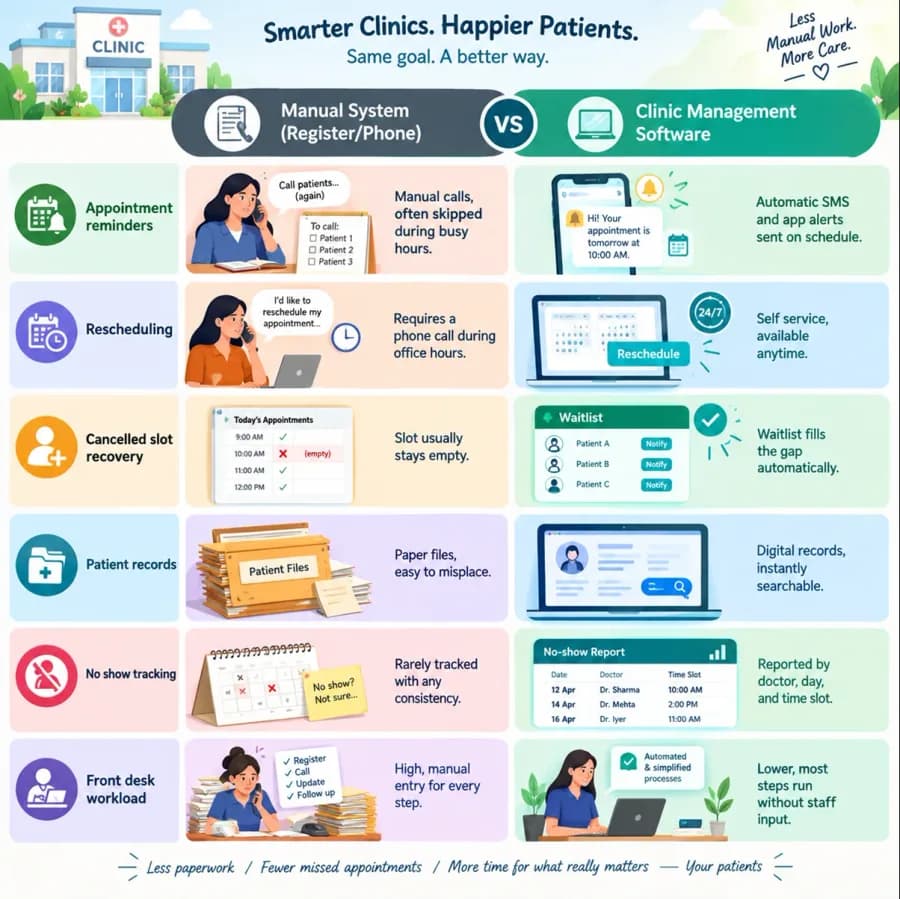
Step 1: Automated Reminders Replace Memory
This is the single highest impact change a clinic can make. A widely cited Cochrane review of patient reminder studies found that text message reminders cut no shows by roughly 29 to 39% compared with sending no reminder at all.
Text messages carry a 98% open rate, and most are read within minutes, far outperforming phone calls that go to voicemail or emails buried in an inbox.
A good system sends these automatically: one confirmation right after booking, then a follow up reminder a day or two before the visit, with the option to confirm or cancel by replying.
Step 2: Online Booking Removes Friction
When patients can see real time doctor availability and book a slot themselves, they are more invested in that choice than when a slot is assigned to them over the phone. Self booked appointments consistently show lower non attendance than phone booked ones, simply because the patient made an active decision rather than agreeing to whatever time was offered.
Step 3: Easy Rescheduling Prevents Silent Drop Offs
If changing plans means calling the clinic during business hours, many patients won't bother, and the appointment quietly becomes a no show. A system that lets patients reschedule with two taps converts a wasted slot into a filled one elsewhere on the calendar.
Step 4: Waitlists Fill Cancelled Slots Instantly
When a cancellation does happen, software with waitlist automation can notify the next patient in line within seconds, instead of leaving that hour empty. This alone can recover a meaningful share of lost revenue without any extra staff effort.
Step 5: Digital Check In and Records Cut Friction on the Day
Long queues and paperwork discourage repeat visits and push some patients to skip follow ups entirely. A quick digital check in, paired with records the doctor can pull up instantly, makes the whole visit faster and more likely to happen on time.
Step 6: Data Shows You Where the Leaks Are
Every clinic has patterns, certain doctors, certain days, certain time slots where no shows spike. A dashboard that tracks this by provider and appointment type lets a clinic manager fix the actual problem area instead of guessing.
Manual Scheduling vs Digital Clinic Software
The Market Is Moving Fast, and for Good Reason
This isn't a niche concern anymore. The global clinical practice management software market was valued at roughly 3.31 billion dollars in 2024 and is projected to reach about 6.83 billion dollars by 2035, growing at a compound annual rate of nearly 6.8%, according to Market Research Future's 2025 industry estimate.
Clinics of every size, from solo practices to multi location wellness chains, are moving away from registers and spreadsheets for exactly the reasons covered above.
Choosing the Right System for Your Clinic
Not every platform covers every gap. When evaluating options, look for:
- Automated multi channel reminders, not just one method
- Self service booking and rescheduling for patients
- A waitlist feature that fills cancellations without manual calls
- Secure digital patient records accessible from any device
- Reporting that breaks down attendance by doctor and time slot
- Support built specifically for how clinics and wellness centers actually run, rather than generic business software adapted for healthcare
Platforms such as Cetasika CMS bundle these pieces together so a clinic isn't stitching together five separate tools just to manage one calendar.
Frequently Asked Questions
What is considered a high no show rate for a clinic?
Most healthcare benchmarks treat anything above 20% as a warning sign worth investigating. Well run clinics using automated reminders and easy rescheduling typically keep this closer to 5 to 10%.
Do appointment reminders really make that much difference?
Yes. Multiple independent studies, including a Cochrane systematic review, found reminder messages cut missed visits by close to a third compared with no reminder at all.
Can clinic management software fully eliminate missed appointments?
No system removes the problem completely. Emergencies and last minute conflicts will always happen. What good software does is shrink the number of avoidable misses, which is the majority of them.
Is this kind of software only useful for large hospitals?
No. Solo practitioners and small wellness centers often see the biggest percentage improvement, since they previously had no automated system at all.
How quickly can a clinic expect to see results after switching?
Most practices notice a drop in missed visits within the first month of turning on automated reminders and online rescheduling, with the fuller benefit showing up over two to three months as patients adjust to the new booking habit.
Final Thoughts
Missed appointments feel like a small, everyday annoyance until you add up what they cost across a year. The patients aren't the problem. Most of them simply forgot, got confused, or had no easy way to change plans.
Clinic management software fixes exactly those failure points, through reminders that actually get read, booking that patients control themselves, and waitlists that catch every cancellation before it becomes wasted time.
For any clinic still running on a register and a landline, this is one of the fastest returns on investment available in healthcare technology today.